

Spectral Calibration & The redshift drift experiment
In astrophysics, we often observe a spectrum from a light-emitting source (star, galaxy, supermassive black hole). The spectrum measures how much light the source emits at different wavelengths. These spectra often have features – emission and absorption lines, and the characteristics of these features reveal a wealth of information about the source – its distance, composition, kinematics, ect.
The expansion of the Universe means that the wavelength of these spectral features moves, or “drifts” in time. Tracking this drift in real time is one of the most sought-after measurements in Physics – it will map the expansion of our Universe in real time and offer insights into its final fate, while also testing whether Einstein was right about General Relativity,
I am building capacity for enabling this experiment. My current research focuses on the ESPRESSO spectrograph (top left image) on the VLT. This spectrograph features laser-frequency combs, extremely accurate spectral calibrators. I am analysing the images of these laser combs (bottom left image) to find novel methods of modelling them that will enable more accurate spectral calibrations, ultimately allowing us to perform the redshift drift experiment and other tests of fundamental physics.
Galaxy evolution
How do galaxies form and evolve? What processes guide their evolution across cosmic time, and how do these processes operate? I am part of three international collaborations addressing these questions – the SAMI, Hector and MAUVE galaxy surveys.
My main research focus outside of enabling fundamental physics is in understanding the formation pathways of galaxies in massive clusters. I am collaborating within the newly completed MAUVE Galaxy survey to answer these questions. MAUVE features remarkably high-resolution observations of galaxies in the Virgo cluster, allowing for an analysis of their chemical composition, ages and kinematics. Working with this state-of-the art data, I aim to map the star formation histories of these galaxies, and inform our theories of this fundamental evolutionary process. Watch this space for more updates on this research.
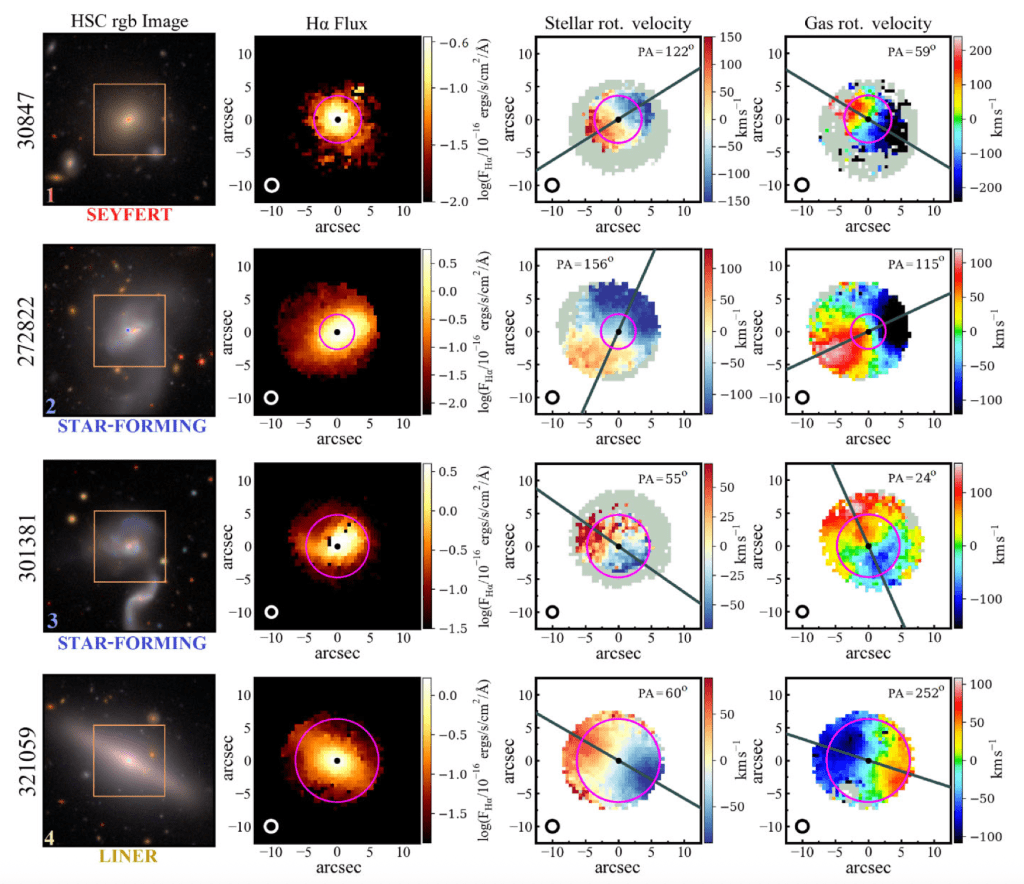
My PhD thesis focused on comparing stellar and gas kinematics in the nearby universe, to understand the processes that shape their evolution, and map their statistical properties. I provided a comprehensive explanation of the processes that lead to misalignments between stellar and gas rotation. I also delivered benchmark measurements of the stellar mass Tully-Fisher and circular velocity functions in the nearby Universe. To find out more, see below for links to my PhD thesis and published papers on these topics.
Ristea et al. 2022 – Kinematic misalignments in the nearby Universe
Ristea et al. 2023 – The Tully-Fisher relation
Ristea et al 2024 – The circular velocity and halo mass functions of galaxies



 Andrei Ristea | Astrophysicist